



Sodium Channel
Na channels; Na+ channels
Sodium channels are integral membrane proteins that form ion channels, conducting sodium ions (Na+) through a cell's plasma membrane. They are classified according to the trigger that opens the channel for such ions, i.e. either a voltage-change (Voltage-gated, voltage-sensitive, or voltage-dependent sodium channel also called VGSCs or Nav channel) or a binding of a substance (a ligand) to the channel (ligand-gated sodium channels). In excitable cells such as neurons, myocytes, and certain types of glia, sodium channels are responsible for the rising phase of action potentials. Voltage-gated Na+ channels can exist in any of three distinct states: deactivated (closed), activated (open), or inactivated (closed). Ligand-gated sodium channels are activated by binding of a ligand instead of a change in membrane potential.
Sodium Channel Isoform Specific Products
-
Sodium Channel
(627)
View all products
-
Nav1.1
(11)
View all products
-
Nav1.2
(16)
View all products
-
Nav1.3
(14)
View all products
-
Nav1.4
(14)
View all products
-
Nav1.5
(21)
View all products
-
Nav1.6
(12)
View all products
-
Nav1.7
(61)
View all products
-
Nav1.8
(41)
View all products
-
Nav1.9
(2)
View all products
All Product Categories
-
Sodium Channel Inhibitors
(619)
View all products
-
Sodium Channel Agonists
(10)
View all products
-
Sodium Channel Antagonists
(30)
View all products
-
Sodium Channel Activators
(35)
View all products
-
Sodium Channel Modulators
(28)
View all products
-
Sodium Channel Controls
(5)
View all products
-
Sodium Channel Ligands
(3)
View all products
-
Sodium Channel Related Products (800)
Related Products (800)

-
Antibodies (9)
-
Related Compound Screening Libraries (1)
-
Sodium Channel Isoform Comparison
-
Lamotrigine N2-Oxide
 0 ImagesCat. No.: HY-W653803CAS No.: 136565-76-9
-
Amiloride-15N3
 0 ImagesCat. No.: HY-B0285SCAS No.: 1217169-93-1Synonyms: MK-870-15N3Amiloride-15N3 (MK-870-15N3) is 15N labeled Amiloride. Amiloride (MK-870) is an inhibitor of both epithelial sodium channel (ENaC) and urokinase-type plasminogen activator receptor (uTPA). Amiloride is a blocker of polycystin-2 (PC2; TRPP2) channel.
-
Mexiletine-d6
 0 ImagesCat. No.: HY-119521S1CAS No.: 1330267-50-9Synonyms: KOE-1173-d6Mexiletine-d6 (KOE-1173-d6) is deuterium labeled Mexiletine. Mexiletine is an orally effective antiarrhythmic agent which has also been found to be effective for myotonia and neuropathic pain. Mexiletine exerts its efficacy through blocking sodium channels (IC50 : 75±8 μM for tonic block, 23.6±2.8 μM for use-dependent block), therefore can be used for cardiovascular and neurological research.
-
Insecticidal agent 21
 0 ImagesCat. No.: HY-173413CAS No.: 3082443-45-3Insecticidal agent 21 (Compound 6) is an insecticide that is effective against Culex pipiens larvae (LC50: 0.4 μg/mL). Insecticidal agent 21 achieves multi-target neurotoxicity by inhibiting acetylcholinesterase (AChE) and simultaneously targeting other neural receptors (nicotinic acetylcholine receptors (nAChR), voltage-gated sodium channels (VGSC), and γ-aminobutyric acid receptors (GABAAR)). Insecticidal agent 21 has a strong insecticidal effect and can be used in the development of new insecticides to address the problem of mosquito resistance to traditional insecticides.
-
Propafenone (Standard)
 0 ImagesSynonyms: SA-79 (Standard)Propafenone (Standard) is the analytical standard of Propafenone. This product is intended for research and analytical applications. Propafenone (SA-79), a sodium-channel blocker, acts an antiarrhythmic agent. Propafenone also has high affinity for the β receptor (IC50=32 nM). Propafenone blocks the transient outward current (Ito) and the sustained delayed rectifier K current (Isus) with IC50 values of 4.9 μm and 8.6 μm, respectively. Propafenone suppresses esophageal cancer proliferation through inducing mitochondrial dysfunction and induce apoptosis.
-
Zeta-Cypermethrin
 0 ImagesCat. No.: HY-W714852CAS No.: 1315501-18-8Zeta-Cypermethrin is a type II pyrethroid insecticide. Zeta-Cypermethrin primarily acts on voltage-gated sodium channels in nerve cells, causing delayed channel closure, persistent nerve excitation and convulsions. In Drosophila, Zeta-Cypermethrin rapidly induces extremely high metabolic resistance that can be screened, and exhibits in vitro genotoxicity to human peripheral blood lymphocytes.
-
Diphenidol-d10 hydrochloride
 0 ImagesCat. No.: HY-A0082SSynonyms: Difenidol hydrochloride-d10Diphenidol-d10 (hydrochloride) (Difenidol hydrochloride-d10) is deuterium labeled Diphenidol (hydrochloride). Diphenidol hydrochloride (Difenidol hydrochloride) is a non-selective muscarinic M1-M4 receptor antagonist, has anti-arrhythmic activity. Diphenidol hydrochloride is also a potent non-specific blocker of voltage-gated ion channels (Na+, K+, and Ca2+) in neuronal cells. Diphenidol hydrochloride can be used in the study of antivertigo and antinausea.
-
AM-2099 (Standard)
 0 ImagesCat. No.: HY-100727RCAS No.: 1443373-17-8AM-2099 (Standard) is the analytical standard of AM-2099 (HY-100727). This product is intended for research and analytical applications. AM-2099 is a potent and selective inhibitor of voltage-gated sodium channel Nav1.7 with an IC50 of 0.16 μM for human Nav1.7.
-
Metaflumizone-d4
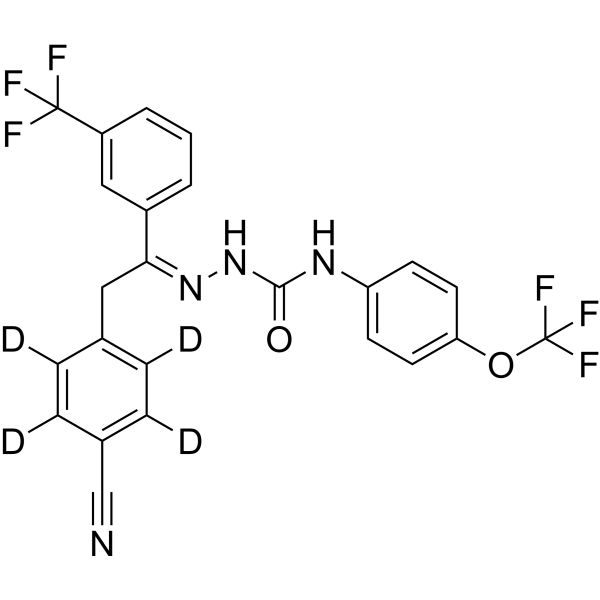 0 ImagesCat. No.: HY-116448SMetaflumizone-d4 is deuterium labeled Metaflumizone. Metaflumizone is a semicarbazone insecticide, acts as a potent sodium channel blocker.
-
Flecainide acetate (Standard)
 0 ImagesSynonyms: R-818 (Standard)Flecainide (acetate) (Standard) is the analytical standard of Flecainide (acetate). This product is intended for research and analytical applications. Flecainide acetate (R-818) is a class 1C antiarrhythmic agent especially used for the management of supraventricular arrhythmia; works by blocking the Nav1.5 sodium channel in the heart, causing prolongation of the cardiac action potential.
-
Lamotrigine-13C7,15N
 0 ImagesCat. No.: HY-B0495S8Synonyms: LTG-13C7,15N; BW430C-13C7,15NLamotrigine-13C7,15N (LTG-13C7,15N) is 13C and 15N labeled Lamotrigine. Lamotrigine (BW430C) is a potent and orally active anticonvulsant or antiepileptic agent. Lamotrigine selectively blocks voltage-gated Na+ channels, stabilizing presynaptic neuronal membranes and inhibiting glutamate release. Lamotrigine can be used for the research of epilepsy,?focal seizure, et al.
-
AHR 10718
 0 ImagesCat. No.: HY-130456CAS No.: 96436-73-6AHR 10718 is an antiarrhythmic agent that suppresses cardiac arrhythmias induced by digitalis intoxication and myocardial infarction in the intact dog. AHR 10718 also depresses membrane responsiveness and conduction, shortens the effective refractory period of specialized conducting fibers less than action potential duration.
-
DPP8/9-IN-2
 0 ImagesCat. No.: HY-175226CAS No.: 3109603-86-0DPP8/9-IN-2 (Compound 21) is a DPP8/9 inhibitor with IC50 values of 0.22 nM and 3 nM, respectively, and Ki values of 2.9 nM and 6 nM, respectively . DPP8/9-IN-2 has certain cardiotoxicity, with IC50 values of 0.7 μM, 29.0 μM and 27.7 μM for hERG potassium channel, Nav1.5 sodium channel and Cav1.2 calcium channel, respectively. DPP8/9-IN-2 can be used in the research of diseases such as tumors.
-
Disopyramide phosphate (Standard)
 0 ImagesCat. No.: HY-12533ARCAS No.: 22059-60-5Synonyms: Dicorantil phosphate (Standard); SC-7031 phosphate (Standard)Disopyramide (phosphate) (Standard) is the analytical standard of Disopyramide (phosphate). This product is intended for research and analytical applications. Disopyramide phosphate is a class IA antiarrhythmic agent with efficacy in ventricular and atrial arrhythmias. Disopyramide phosphate blocks the fast inward sodium current of cardiac muscle and prolongs the duration of cardiac action potentials. Disopyramide phosphate inhibits HERG encoded potassium channels. Disopyramide phosphate also exhibits complex protein binding, and has a potent negative inotropic action.
-
Meticrane (Standard)
 0 ImagesMeticrane (Standard) is the analytical standard of Meticrane. This product is intended for research and analytical applications. Meticrane is a diuretic. Meticrane inhibits the reabsorption of sodium and chloride ions in the distal convoluted tubule. Meticrane is used to treat essential hypertension.
-
PF 04531083 (Standard)
 0 ImagesCat. No.: HY-105283RCAS No.: 1079400-07-9PF 04531083 (Standard) is the analytical standard of PF 04531083 (HY-105283). This product is intended for research and analytical applications. PF 04531083 is an orally active and selective NaV1.8 blocker with an IC50 of 0.7 μM. PF 04531083 is a blood-brain barrier (BBB) penetrant compound. PF 04531083 can be used for the research of respiratory system and neuropathic/inflammatory pain.
-
Crobenetine
 0 ImagesCat. No.: HY-16923CAS No.: 221019-25-6Synonyms: BIII-890; BIII-890 CL free acidCrobenetine (BIII-890), a benzomorphan derivative, is a potent, selective, and highly use-dependent Na+ channel blocker. Crobenetine displaces [3H]BTX from site 2 of the Na+ channel (IC50=49 nM) in rat brain synaptosomes, yet exhibits only low binding affinity for other receptors and ion channels. Crobenetine protects brain tissue from the deleterious effects of focal cerebral ischemia in rodents.
-
GS967 (Standard)
 0 ImagesGS967 (Standard) is the analytical standard of GS967. This product is intended for research and analytical applications. GS967 (GS-458967) is a potent, and selective inhibitor of cardiac late sodium current (late INa ) with IC50 values of 0.13 and 0.21 μM for ventricular myocytes and isolated hearts, respectively.
-
Myomodulin
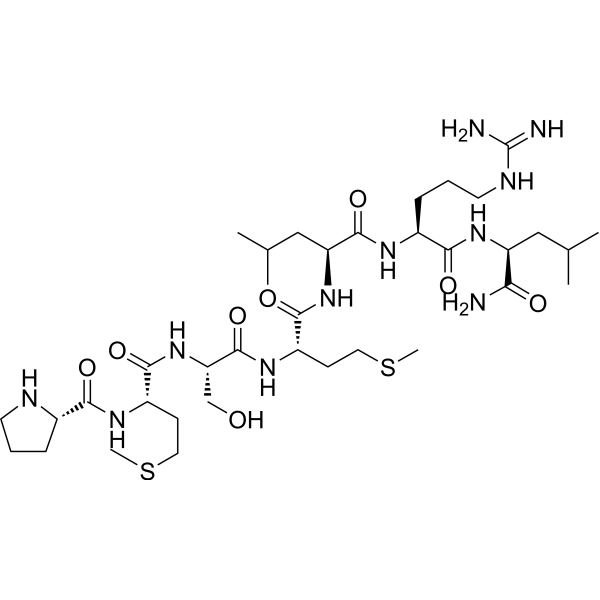 0 ImagesCat. No.: HY-P0268CAS No.: 110570-93-9Myomodulin is a neuropeptide present in molluscs, insects, and gastropods.
-
(5R)-BW-4030W92
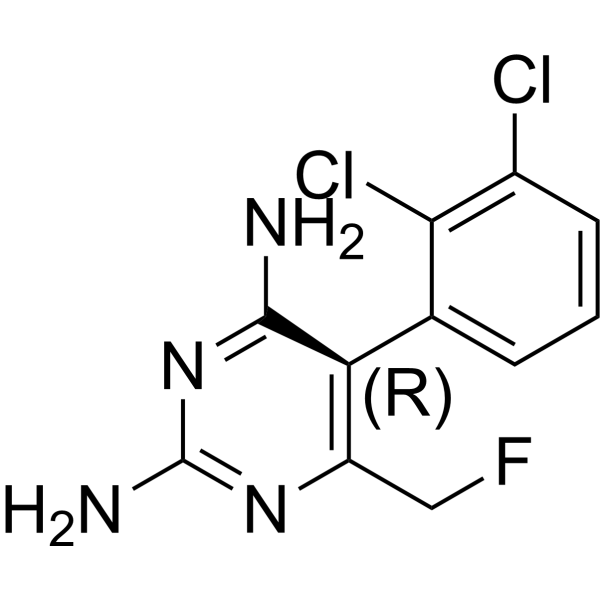 0 ImagesCat. No.: HY-19282ACAS No.: 189013-61-4(5R)-BW-4030W92 is the R enantiomer of BW-4030W92. BW-4030W92 is a non-selective, voltage-, and use-dependent sodium channel antagonist.




